Missions resumed in the 1840s at Lagos and Ibadan by the Church of England’s Missionary Society. Other denominations followed them from Britain, Canada, and the U.S. They were Protestants. In the 1860s the Roman Catholics followed as well. To avoid competition with other missionaries in the field the Protestant Missionaries divided the country by mission activities. Catholic missionaries avoided missions in areas already under influence of other missionaries. The Catholics were active among the Igbos and the Church of England among the Yoruba’s.[2]
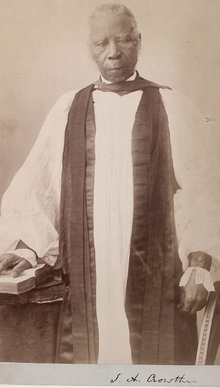 | ||
| Samuel Crowther Bishop in 1867 Translated the Bible in Yoruba language[6] |
After WWI the Brethren, seventh Day Adventist and Jehovah’s Witnesses came on the scene in small sects. African-American churches also entered the missionary field and created contacts with Nigeria that lasted up into colonial period.[4] Between 1953 and 1960 there were riots against the Igbos due to religious conflicts. Riots happened again in the North of 1966 against the Igbos, supposedly due to their mistreatment of Muslims.[5]
 | |
| Igbo Roman Catholics in the Cathedral[7] |
[1]Helen Metz. Nigeria: A Country Study.
[2]Lbid.
[3]Lbid.
[4]Helen Metz, Influence of The Christian Mission.
[5]Lbid.
[6] Wikipedia. Samuel Ajayi Crowther, Image.
[7] Wikimedia. Igbo Roman Catholics in the Cathedral, Image.
Bibliography
Metz, Helen Chapin. "Christianity." Nigeria:
A Country Study. The Library of Congress, 1991.
http://countrystudies.us/nigeria/47.htm (accessed February 25, 2016).
—. "Influence of The Christian Missions." Nigeria:
A Country Study. The Library of Congress,1991.
http://countrystudies.us/nigeria/14.htm (accessed February 25, 2016).
Wikimedia. Igbo Roman Catholics in the Cathedral
of Our Lady of the Angels, Los Angeles, California Image. n.d.
https://upload.wikimedia.org/wikipedia/commons/f/fc/Igbo_Roman_Catholics.jpg
(accessed February 25, 2016).
Wikipedia. Samuel Ajayi Crowther Image. n.d.
https://en.wikipedia.org/wiki/Samuel_Ajayi_Crowther (accessed February 25,
2016).
